
What a Virtual Assistant Actually Does for Clients in Kenya (Beginner Guide)
If you’ve searched “virtual assistant jobs in Kenya” recently, you’ve probably seen one of two things:
Someone promising you “easy dollars from home” after watching three videos
Someone is making it sound so complicated that you feel like you need a computer science degree just to reply to emails
Neither is accurate.
So let’s simplify this properly.
Because a lot of Kenyans are hearing about remote work and virtual assistant opportunities, but very few people are explaining what the work actually looks like day-to-day. Even worse, Google results are full of noise, recycled advice, and fake “make money online” gurus.
You do not need hype.
You need clarity.
And that’s exactly what this guide is for.
First: What Is a Virtual Assistant?
A Virtual Assistant, usually called a VA, is someone who helps a business owner or company complete important tasks remotely using a laptop and internet connection.
That’s it.
A VA is not one specific job.
It’s a category of digital support work.
Some VAs handle emails.
Some schedule meetings.
Some organize files.
Some manage social media.
Some help with customer support.
Some do research.
Some eventually help businesses run entire systems.
Think of it this way:
A business owner is overwhelmed.
Your job is to help reduce chaos.
That’s the real role.
What Do Virtual Assistants Actually Do Every Day?
Here’s where many beginners get confused.
People hear “virtual assistant” and imagine somebody typing randomly on a laptop in a Nairobi café while drinking iced coffee like a Netflix startup founder.
Reality is less glamorous.
But also more achievable.
Most beginner VAs start with operational support tasks.
Here are real examples of work clients pay for:
1. Email Management
A client may receive hundreds of emails every week.
Your job could include:
Organizing inboxes
Flagging important messages
Responding to simple emails
Deleting spam
Following up with leads or customers
You are helping the client stay organized and avoid missing important things.
2. Calendar Scheduling
Many business owners are terrible at managing time.
Seriously. Some CEOs operate like they are fighting for survival every Monday morning.
A VA may:
Schedule meetings
Send reminders
Prevent double bookings
Coordinate Zoom calls
Organize appointments
This sounds simple until you realize one missed meeting can cost a business money.
Reliability matters.
3. Research Tasks
Clients constantly need information.
For example:
Finding podcast opportunities
Researching competitors
Looking for suppliers
Gathering contact information
Summarizing articles
Finding trending topics
Good research saves businesses time.
And time is money.
4. Customer Support
Some VAs help answer customer questions through:
Email
WhatsApp
Instagram DMs
Live chat
This is not just “replying to messages.”
You are representing the company.
Professional communication matters.
5. File and Task Organization
Businesses become messy very quickly.
A VA may organize:
Google Drive folders
Documents
Spreadsheets
SOPs
Task trackers
This sounds boring until you realize some businesses waste hours daily searching for files named:
FINAL_FINAL_v2_USETHISONE.pdf
We must stop this as a society.
6. Basic Content Support
Some beginner VAs also help with:
Scheduling social media posts
Uploading blogs
Simple Canva edits
Updating websites
Repurposing content
Not every VA becomes a designer or marketer.
But understanding basic content systems helps.
The Truth Most People Won’t Tell You
Being a successful VA is less about “knowing tools” and more about thinking clearly.
This is where many people struggle.
A client does not just want someone who follows instructions like a robot.
They want someone who can:
Understand tasks properly
Communicate clearly
Solve small problems independently
Stay organized
Finish work correctly
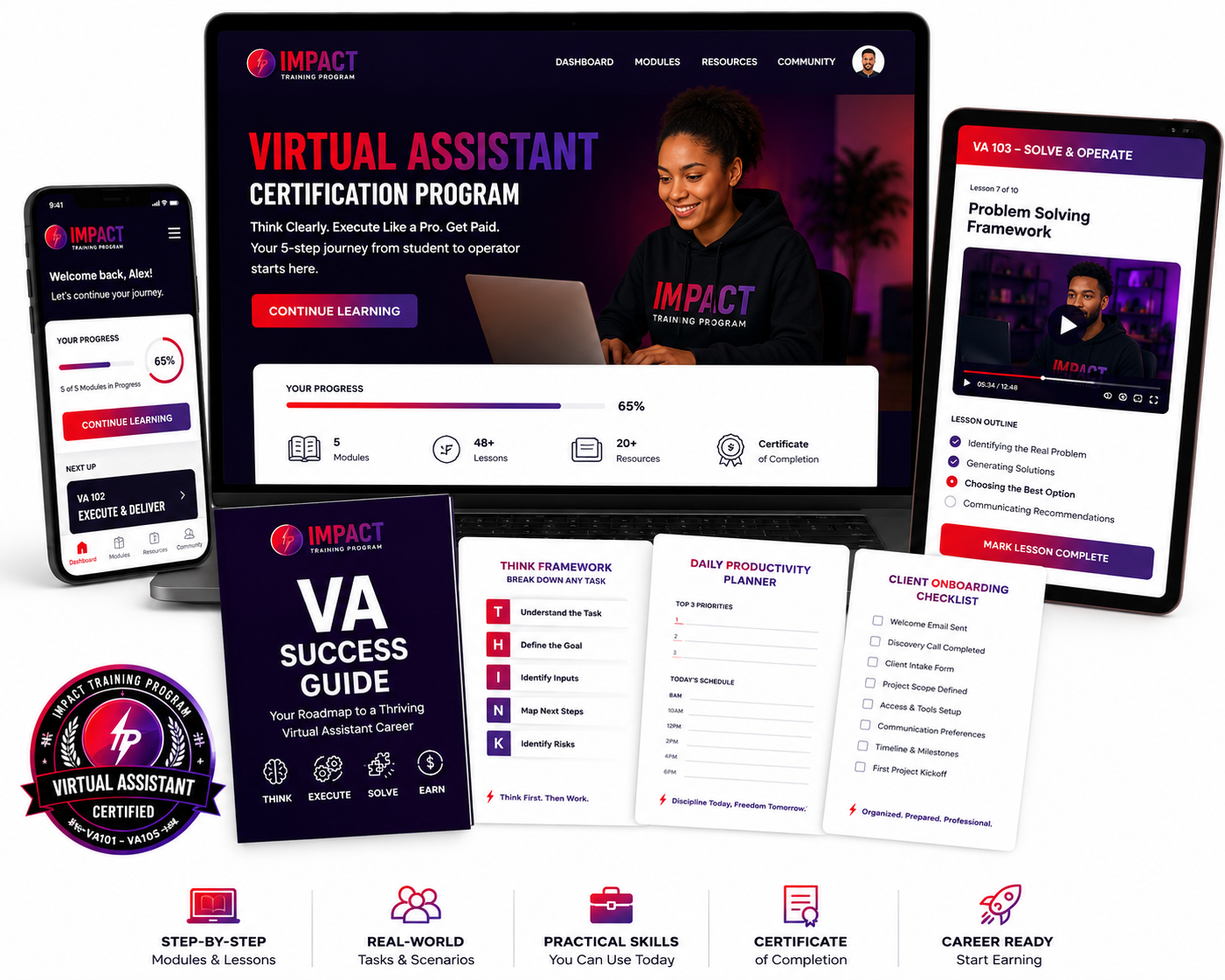
That’s why the IMPACT Training Program focuses heavily on thinking before tools.
Because clicking buttons is easy.
Thinking through problems is harder.
And businesses pay more for people they can trust.
Do You Need Experience to Start?
Not necessarily.
But you do need capability.
There’s a difference.
Many Kenyan graduates already have some useful skills:
Writing emails
Organizing information
Communicating professionally
Using Google Docs
Researching online
Managing schedules
The problem is that most people were never taught how to apply those skills professionally in digital work environments.
That gap is exactly why so many educated graduates still feel stuck.
Do Clients Care That You’re in Kenya?
Some beginners worry about this constantly.
But here’s the truth:
Many international clients already hire Kenyan talent.
Why?
Because Kenya has:
Strong English communication
Educated young workforce
Good timezone overlap with Europe and parts of the US
Growing digital talent
The bigger issue is usually not location.
It’s professionalism and execution.
Can you communicate clearly?
Can you follow through?
Can you think independently?
Can you solve problems calmly?
That matters more than your location most of the time.
What Skills Should Beginners Focus On First?
Do not try to learn 47 tools at once.
Start with foundational execution skills:
Focus on:
Communication
Organization
Task management
Research
Time management
Professional writing
Google Workspace basics
Then build upward.
The mistake many beginners make is chasing advanced tools before they can consistently complete simple workflows.
That creates fake confidence without real capability.
What Makes Someone Valuable as a VA?
Here’s the real answer:
Ownership.
Clients love people who:
Think before asking
Catch mistakes early
Communicate proactively
Stay calm when things break
Focus on outcomes instead of excuses
At IMPACT, one of the core ideas is simple:
Do not bring problems without at least one proposed solution.
That mindset alone separates beginners from operators.
The Biggest Mistake Beginners Make
Tutorial addiction.
Watching endless YouTube videos without practicing real execution.
You do not become job-ready by consuming information endlessly.
Confidence comes from completing real workflows.
That means:
Doing tasks
Making mistakes
Fixing mistakes
Explaining your thinking
Improving over time
That’s how professionals are built.
Final Thoughts
Virtual Assistant work is real.
But it is not magic money.
It is structured digital work that rewards organization, communication, consistency, and problem-solving.
The good news?
These are learnable skills.
Especially for Kenyan students and graduates who are willing to stop chasing shortcuts and start building real capability.
You are not behind.
You were probably just undertrained.
Free Beginner Resource 🎁
If you want a practical starting point, download:
The Kenyan Beginner’s Virtual Assistant Starter Kit
Inside you’ll get:
25 real beginner VA tasks
Beginner skill checklist
Scam-check guide
Recommended tools
Simple first-client roadmap
Perfect if you’re still trying to understand how this industry actually works.
Ready to Build Real Skills?
The IMPACT Training Program was designed specifically for ambitious but underprepared learners in Kenya who want more than motivation videos and vague advice.
Our Virtual Assistant Certification helps you learn how to:
Think through tasks properly
Execute real digital work
Solve problems independently
Build professional confidence
Prepare for real client opportunities
Because the goal is not just to “learn online.”
The goal is to become someone businesses can rely on.